
How to Estimate Wine for Your Guests and Party Length

Updated: Nov 16
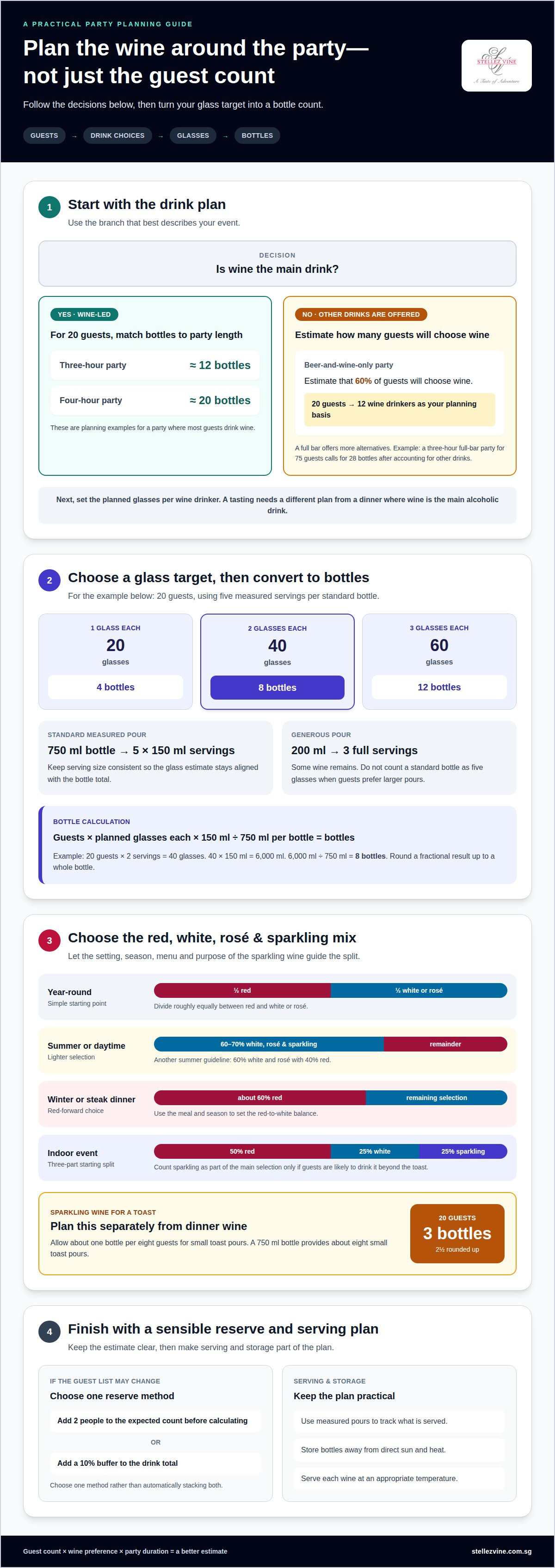
For a three-hour party where most guests drink wine, plan on about 12 bottles for 20 people. If the celebration lasts four hours and wine is the main drink, allow about one bottle per guest, or 20 bottles. The best estimate of how much wine for a party of 20 depends not just on the headcount, but on how long guests stay and how many choose wine.
It’s easy to focus on the guest list and overlook how quickly the evening may unfold. Start with the party’s duration, then adjust for guests’ wine preferences and the other drinks on offer. A short gathering with a full bar calls for a different plan from a long, wine-led dinner.
Use the guide below to estimate bottles and glasses, tailor quantities to your guests’ preferences, and choose a balanced mix of red, white, rosé, and sparkling wines. It’s a practical starting point for hosting in Singapore, with room to shape the selection around your menu and the mood of the occasion.
Table of Contents
Wine Calculator: How Many Bottles of Wine Does Your Dinner Party Need?
For a three-hour party where most guests drink wine, plan about 12 bottles for 20 people; a four-hour wine-led event calls for about 20 bottles. To estimate how much wine for a party of 20, match your glass target to the event’s duration and guests’ preferences. Store bottles away from direct sun and heat, and serve each wine at an appropriate temperature.
Estimate glasses from each bottleStart with the pour size: a standard 750 ml bottle provides five measured 150 ml servings. That gives you a straightforward conversion, but generous pours change the yield. At 200 ml per glass, a bottle provides three full servings, with some wine remaining. Avoid counting a bottle as five glasses if your guests prefer larger pours.Use the same serving size throughout your estimate. Consistent pours make it easier to track what’s being served with dinner.
Set a glass target per guestChoose one, two, or three planned glasses per guest. For 20 guests, those targets equal 20, 40, or 60 glasses. Using five measured servings per standard bottle, that converts to four, eight, or 12 bottles respectively.To decide how much wine for a party of 20 to buy, consider whether wine is the main drink or one of several options. The glass target should reflect the occasion, not just the headcount.
Convert planned pours into bottlesMultiply the guest count by the planned glasses per person, then multiply the total glasses by 150 ml. For 20 guests planning two servings each, that equals 6,000 ml. Divide by 750 ml per standard bottle to get eight bottles. Round a fractional result up to a whole bottle.For a tasting, one bottle of each wine can serve up to 12 guests when offering four to six wines. At a formal dinner, larger-format bottles can add presence to the table. Base your calculation on each bottle’s stated volume, rather than assuming it holds the same amount as a standard bottle.Calculating how much wine for a party of 20 this way keeps the guest count, pour size, and bottle total aligned.
Red, white, rosé, and sparkling wine proportions
Choose the mix around the setting, season, menu, and whether sparkling wine is for a toast or the whole party. For a toast for 20 people, allow three bottles of sparkling wine, using about one bottle per eight guests and rounding up.
Choose red, white, and rosé winesStart with the party setting and meal: a summer afternoon may suit a lighter mix, while a winter dinner can feature more red. For a year-round selection, divide the order roughly equally between red and white or rosé. Keep rosé in the lighter portion, and consider how each wine will pair with the courses.For example, a menu with several courses can benefit from both red and white choices, rather than a single style. If you’re exploring a different selection for the table, discover South African wines as one option.
Divide the order between red and whiteUse the meal and season to set the red-to-white balance. A simple year-round starting point is half red and half white or rosé; for a summer or daytime party, shift toward 60-70% white, rosé, and sparkling wine. For a winter party or steak dinner, make red wine about 60% of the selection.Apply the ratio to your planned wine order, then round to whole bottles. Don’t let the menu dictate every choice: a mixed selection gives guests options across courses and preferences.
Set proportions for red, white, and sparklingFor an indoor event, use a 50% red, 25% white, and 25% sparkling split as a starting point. For a warm outdoor party, consider choosing a mix that suits the setting and guests’ preferences. In summer, another guideline is 60% white and rosé with 40% red, so choose the split that best suits your setting.Keep serving size in mind as you divide the order. Count sparkling wine as part of the main selection only if guests are likely to drink it beyond the toast.
Plan sparkling wine for the toastSet aside about one bottle for every eight guests when serving a small toast pour. For 20 people, that works out to two and a half bottles, so round up to three. A 750 ml bottle provides about eight small toast pours, making this a distinct calculation from bottles intended for full glasses.Plan toast pours separately from the dinner wine tally. This keeps the sparkling allocation clear and leaves your red, white, or rosé proportions intact.
Adjusting quantities for guests who choose wine
Base the order on how many guests are likely to drink wine, not just the total headcount. Then adjust for the bar menu, party length, and a small contingency.
Adjust the quantity for the guest countStart with the number of guests and the share likely to choose wine. At a beer-and-wine-only party, estimate that 60% of guests will choose wine. For 20 guests, that means using 12 wine drinkers as the planning basis before accounting for party length and servings per person.For a larger example, a three-hour party with 75 guests and a full bar calls for 28 bottles of wine after accounting for other drinks. The full bar matters: guests can choose beer or mixed drinks instead, so don’t apply a wine-only estimate to this event.Keep the calculation consistent: first identify who is likely to drink wine, then apply the serving target for the event. A wine tasting also needs a different plan from a dinner where wine is the main alcoholic drink. Tasting pours are smaller, so the guest count alone won’t give you the right bottle total.
Allow for unexpected guestsBuild a modest reserve into your estimate if the guest list may change. One approach is to add two people to the expected count before calculating; another is to add a 10% buffer to the drink total. Choose one method and apply it to the base estimate, rather than stacking both automatically.Add a reserve after estimating how many guests will choose wine, especially if beer or a full bar is available. This keeps extra bottles in line with likely wine drinking rather than the entire guest count. Don’t count guests who aren’t expected to drink as wine drinkers simply because they’re attending.For a 75-person event, use the 28-bottle full-bar estimate as the base before applying any buffer. This separates the core order from contingency stock and makes the adjustment easy to track.
Predicting glasses consumed by party duration and wine preference
For 20 guests at a two-hour party, plan about 40 glasses if wine is the main drink. That works out to eight standard bottles using five measured glasses per bottle.
Estimate glasses by party duration and preferenceMultiply the party hours by the expected glasses per guest per hour, then multiply by guests. For an average crowd, use one drink per guest per hour. For 20 guests over two hours, that means 40 glasses if each drink is wine.Adjust for preferences: light-drinking guests may average three-quarters of a drink hourly, while a lively crowd may average one and a quarter. Over two hours, those estimates become 30 or 50 glasses for 20 guests. Use the lower or higher figure to reflect the crowd, not as an automatic allowance for every gathering.Count only wine in your wine total. If guests can choose beer or other drinks, estimate how many are likely to choose wine. A dinner focused on wine calls for a different estimate from an event with a mixed drinks menu.
Estimate wine for a two-hour partySet the guest count at 20 and choose the drinking pace. At one glass per person per hour, the total is 40 glasses. With five measured servings from each standard bottle, that equals eight bottles. For light drinkers, 30 glasses converts to six bottles; for a lively crowd, 50 glasses converts to 10.Use your results as a starting point, then adjust for the menu and other drink choices. If wine is one of several options, estimate the share of guests likely to choose it rather than counting everyone as a wine drinker. Keep the pour size consistent so the glass and bottle totals stay aligned.
Explore wines for your gathering and shape a selection around your guests’ preferences.
Stellez Vine Singapore
Stellez Vine helps you turn your party estimate into a considered wine selection, with wines from renowned regions and options for storing bottles at home. Once you’ve set the quantity and style mix, explore South African wines or Savage wines to create a varied selection for the table.
For future gatherings, explore Kadeka wine chillers, Eurocave wine fridges, and Liebherr wine cabinets for storing your collection. Choose wines that suit your menu and guests, then store any remaining bottles appropriately for another occasion.
For a wine selection that fits your gathering, contact Stellez Vine Singapore.
Make your next gathering a thoughtful pour
Let the occasion shape more than the bottle count. A menu, setting, and guest preferences can guide a selection that feels personal, whether you’re hosting a relaxed dinner or a celebratory evening. Estimating how much wine for a party of 20 is a useful starting point; the final choice can reflect the experience you want to create.
For hosts looking to elevate the entertainment beyond drinks and dining, curating engaging activities at home—like setting up an immersive racing simulator room with equipment from S5 Tech—can make any gathering even more memorable.
As you plan future gatherings, explore South African wines for the table and consider Kadeka wine chillers or Eurocave wine fridges for storing wine at home. Match the wines you choose with how you enjoy and store them beyond a single occasion.
Bring your gathering plans and wine preferences to the next step. Contact Stellez Vine Singapore to explore a selection that suits your occasion, then raise a glass to hosting with confidence.
Frequently Asked Questions
Second, how many glasses of wine will each guest drink?
For an average party crowd, estimate one drink per guest per hour, then adjust for the event’s length and guests’ preferences. A lighter-drinking group may average three-quarters of a drink per hour; a lively crowd may average one and a quarter. Treat these as planning estimates, not fixed limits. If other drinks are available, account for guests who may choose them instead of wine.
Does a larger pour change the bottle count?
Yes. A 750 ml bottle provides five 150 ml servings, but larger pours reduce the number of glasses. At 200 ml per pour, the bottle serves three full glasses, with some wine remaining. For a dinner, decide whether to serve measured pours or more generous glasses first, then calculate the total using that same serving size throughout.
How Much Alcohol Do You Need for a Party?
Estimate total drinks by multiplying the guest count by the party hours and expected drinks per guest per hour. Use one drink per guest per hour for an average crowd, then adjust for lighter or livelier preferences. Divide the total among wine, beer, and other options according to what you plan to serve. Keep water and non-alcoholic choices available, too.
How many glasses of wine does one bottle serve?
A standard 750 ml bottle serves five measured 150 ml glasses. The actual count depends on the pour: larger servings use more wine and yield fewer glasses. For example, a 200 ml pour gives three full servings from a bottle. Choose a consistent serving size before estimating, especially if you’re pouring at the table rather than measuring each glass.
How many drinks per guest should I plan for a party?
For an average crowd, use one drink per guest per hour as a starting estimate. Adjust to three-quarters of a drink per hour for a lighter-drinking group or one and a quarter for a lively crowd. Then account for the gathering’s length and the drinks available. These estimates help you plan quantities; they aren’t a reason to encourage guests to drink more.
How much wine for 20 guests for a 4-hour party?
For a four-hour party where wine is the main drink, use the guideline of one bottle per person: plan 20 bottles for 20 guests. This is a wine-led estimate. If beer or other drinks will also be served, reduce the wine share to reflect guests’ choices rather than applying the wine-only total unchanged.
Comments