
Choosing a Kadeka Wine Chiller for Your Singapore Home

A wine chiller is still worth buying when you want your bottles stored in a dedicated space, rather than squeezed into a general-purpose fridge. The Kadeka wine chiller range in Singapore spans compact options listed for 19 bottles to larger models listed for 183, so there’s a size for different collections and home layouts.
Choosing a Kadeka wine chiller takes more than counting bottles. Bottle shape, shelf layout, glass-door design, installation space and price all affect whether a model suits your home and collection. Capacity is a useful guide, but oversized bottles and different shelf configurations can change how much fits in practice.
Compare Kadeka models by capacity and features, and consider how shelves, glass doors and placement fit your needs. This guide will help you narrow your options to a chiller suited to your collection, available space and the way you enjoy wine.
Table of Contents
Kadeka wine chiller price in Singapore
Kadeka wine chiller prices in Singapore vary by model and format. Compare units by capacity, series and intended placement rather than price alone. A chiller for a smaller collection serves a different need from a large cabinet. Start by assessing your collection and available space.
Model names help make the range easier to assess. The Signature Series includes the KSP29TL/R, listed for 29 bottles, and the KSP183TL, listed for 183. The Steel Series includes the KN24WR, listed for 19 bottles, and the KN165T, listed for 155. These capacities illustrate how widely model sizes can differ.
For a practical shortlist, first estimate how many bottles you want stored together. Then compare models with capacities near that need, allowing room for your collection to change. The KSP40TL holds 40 bottles, while the KSP96TL holds 96. Their stated capacities offer a clearer starting point than comparing names or appearance alone.
Singapore product prices also differ between wine chillers and wine cabinets. Kadeka model names sometimes use “Wine Cabinet,” including the 31 Bot Wine Cabinet and 46 Bot Dual Zone Wine Cabinet. Read the full model description, then compare capacity, zones and placement needs. Don’t assume that similar bottle counts mean identical features or use.
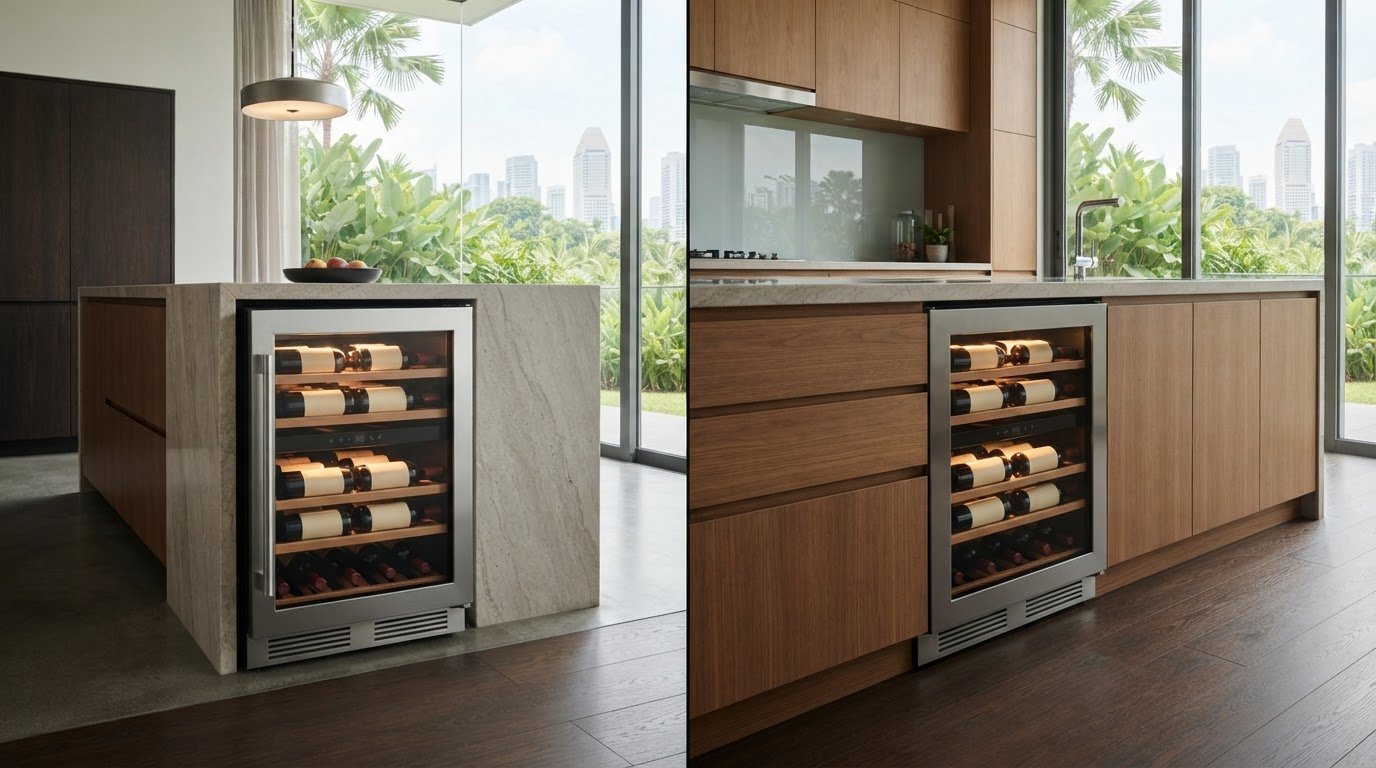
Before setting a budget, consider where the chiller will go. For an undercounter installation, measure the unit and surrounding space, then allow for ventilation and the required clearance. These constraints can narrow your options before price becomes the deciding factor.
How energy-efficient and quiet are Kadeka wine chillers? Kadeka says its inverter technology enables silent operation and continuously regulates temperature for consistency. Compare this feature with your needs, especially if the chiller will be near a living area.
What warranty and after-sales service does Kadeka offer in Singapore? Warranty coverage and after-sales support are separate from a model’s capacity and price. Before buying, review the specific unit’s coverage period, exclusions and service process.
Are Kadeka wine chillers suitable for Singapore’s hot, humid climate? They can suit a home when installed with the required ventilation and clearance. Keep the chiller away from heat sources and maintain airflow around it so its placement does not hinder temperature control.
Use three checks to make a sound comparison: collection size, installation space and the features that matter in daily use. A KN24WR and a KSP183TL serve very different storage needs, even within the same brand. Compare the exact model specifications, then weigh them against your home’s layout and your preferred temperature setup.
Bottle size and shelf compatibility
Compare the stated bottle capacity with what you actually store. Kadeka’s listed counts offer a useful baseline, while bottle shape and shelf layout affect practical fit.
Kadeka Bottle Capacity
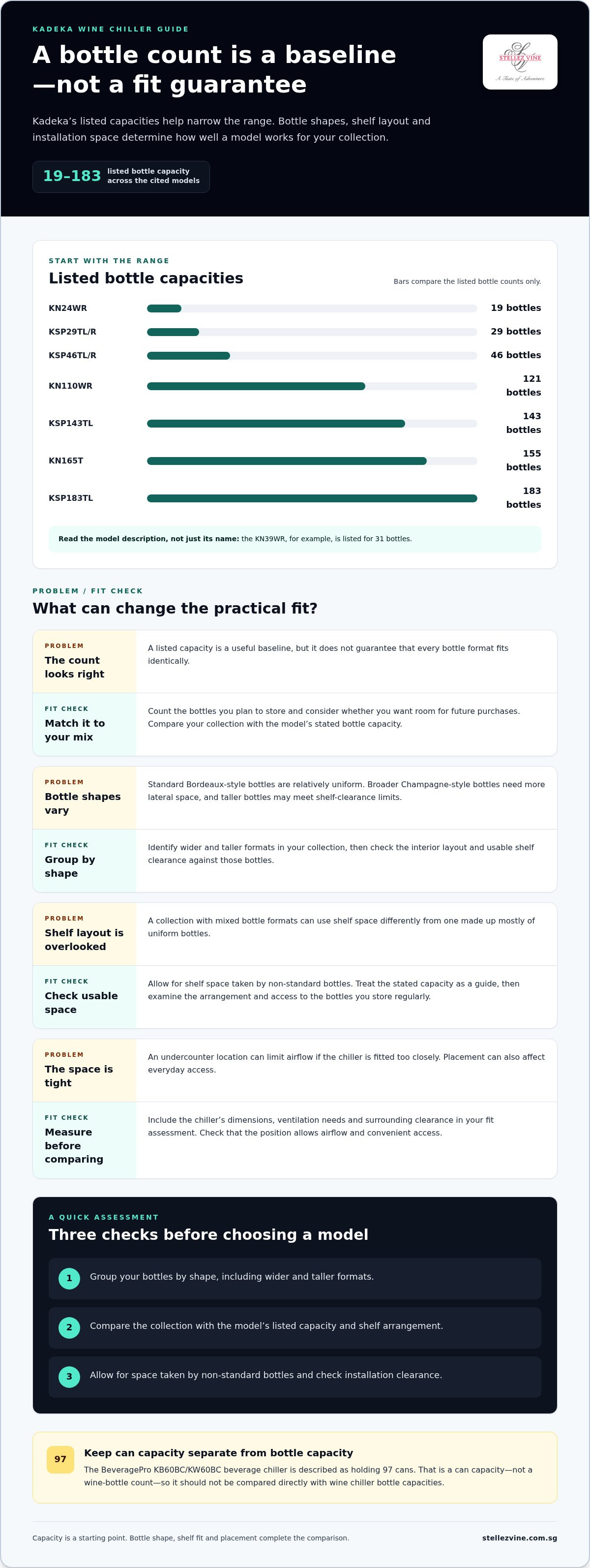
Kadeka wine chiller capacities range from compact storage to larger collections. The Steel Series KN24WR is listed for 19 bottles, while the Signature Series KSP29TL/R holds 29. Larger examples include the KN110WR at 121 bottles and KN165T at 155. Use these figures to shortlist a size that suits your collection, not as a guarantee that every bottle format fits identically.
Compact: KN24WR, 19 bottles.
Mid-size: KSP46TL/R, 46 bottles.
Large: KSP143TL, 143 bottles.
Extra capacity: KSP183TL, 183 bottles.
Listed capacities show the available range, but your own mix matters. Count the bottles you plan to store and consider whether you want room for future purchases. Standard-shaped bottles may fit differently from a collection with varied formats.
Bottle Size and Shelf Fit
Bottle dimensions affect how neatly bottles sit and how many fit on each shelf. Standard Bordeaux-style bottles are relatively uniform, while broader Champagne-style bottles need more lateral space. Taller bottles may also run into shelf-clearance limits. Check the interior layout against your bottles, especially if your collection includes several shapes.
Use this simple assessment before choosing a model:
Group bottles by shape, including wider and taller formats.
Compare your collection with the model’s listed capacity.
Allow for shelf space taken by non-standard bottles.
For example, a model listed for 46 bottles may suit a mostly uniform collection differently from a collection mixing standard and wider bottles. Treat the capacity as a guide, then examine the shelf arrangement and usable clearance. Avoid assuming a model number indicates its bottle count: the KN39WR, for example, is listed for 31 bottles.
For an undercounter installation, include the chiller’s dimensions, ventilation needs and surrounding clearance in your fit assessment. A close fit can limit airflow, while an unsuitable shelf layout can make regular access awkward. Explore wine storage options once you’ve narrowed your shortlist by bottle shape and capacity.
Capacity comparisons should stay tied to the kind of item being stored. The Kadeka BeveragePro KB60BC/KW60BC beverage chiller is described as holding 97 cans. That figure is a can capacity, not a wine-bottle count, so it should not be compared directly with the bottle capacities as though the units were interchangeable. If your requirement is wine storage, assess a wine chiller using your own bottle shapes and its stated bottle capacity; if you are evaluating this beverage chiller, use the can figure for its stated purpose. Keeping those measures separate makes a shortlist clearer and avoids treating a can-based specification as evidence of bottle fit.
Glass door features
A glass door makes bottle labels visible without opening the cabinet. That display can suit a dining area or kitchen, where the chiller remains part of the room’s design. Kadeka’s BeveragePro KB60BC/KW60BC beverage chiller has a double-layer Low E glass door. It’s a specific feature to weigh alongside placement and intended use.
Low-E glass is designed to limit heat transfer through the door. Double-layer construction adds a second pane, creating an insulating layer between the interior and the room. This describes the door construction, not a specific temperature setting or energy-use figure. For any glass-door unit, consider how its location and surroundings affect everyday operation.
A glass door lets you see your drinks at a glance, but it also makes the appliance more visually prominent. Consider the door’s position relative to windows, lighting and seating. Avoid a spot where glare makes labels hard to see, and leave enough room to open the door and retrieve bottles or cans.
Check the view: Position the door where labels remain easy to see.
Consider the room: Match the visible appliance with your kitchen or dining layout.
Plan access: Leave space to open the door and reach stored drinks.
The BeveragePro KB60BC/KW60BC is a beverage chiller, not a wine-storage substitute. Its listed capacity is 97 cans or 7 bottles, and it has an adjustable glide shelf. Those details make it useful to assess for drinks alongside its glass-door design. Wine has different temperature and storage requirements from beverages kept in a back bar cooler for serving.
This distinction matters when comparing a glass-fronted drinks unit with a dedicated wine chiller. Start by deciding what you intend to store. If wine is your main collection, prioritise wine-storage needs. If you want serving drinks on display, assess a beverage chiller’s capacity and shelf layout. A glass door alone does not determine the right choice.
Before choosing, compare three practical points: door visibility, the unit’s purpose and the room’s layout. For example, the KB60BC/KW60BC combines a double-layer Low E glass door with an adjustable glide shelf, but its beverage capacity describes drinks storage. Use those specifics to decide whether the feature suits your home, rather than treating every glass-door cabinet as interchangeable.
Kadeka wine chiller range
Kadeka’s range includes distinct series and formats, from single-zone storage to models with separate temperature zones. Compare each option by your collection’s needs, interior layout and cooling features.
Available Chiller Options
Start by comparing the Steel, Signature and Medley series. The Steel and Signature ranges include models for different collection sizes. Kadeka created the Medley series in 2021, adding a separate compartment with its own temperature zone and customisable racking. That configuration suits households storing different wines together, while allowing the rack layout to reflect the collection.
Series names are a starting point, not a complete specification. Check each model’s capacity, dimensions, shelf layout and temperature setup. A household storing wines for ageing and serving, for example, may value separate zones more than extra capacity. If you keep your collection at one storage condition, a simpler layout may suit you. Match the format to how you plan to use it.
Installation also shapes the shortlist. An undercounter chiller needs suitable dimensions, ventilation and surrounding clearance. A freestanding unit has different placement considerations, including access and available floor space. Measure the intended location before comparing models. This step helps rule out a unit that suits the collection but not the home.
Temperature Ranges and Cooling Features
Kadeka says its inverter technology continuously regulates temperature for consistency and enables silent operation. These features matter for a chiller used regularly, particularly near living spaces. Compare the cooling system and temperature controls of the exact model, then consider whether its storage layout suits your wines.
Some Kadeka options have distinct temperature arrangements. The Medley series has a separate compartment with its own temperature zone, while Kadeka describes the BeveragePro KB60BC/KW60BC as having precise temperature control. BeveragePro is a beverage chiller, so don’t treat it as equivalent to a dedicated wine-storage model. Wine and serving beverages have different storage requirements.
Use a three-part comparison before choosing:
Collection: Decide whether you need one or separate temperature zones.
Controls: Compare the model’s temperature settings and regulation features.
Placement: Consider operating noise and installation clearance.
For example, a Medley model’s separate compartment can provide two storage zones in one unit. A Kadeka model with inverter technology offers continuous temperature regulation and silent operation. These features address different priorities, so weigh them against the wines you store and where the chiller will sit. Choose by the specific model’s configuration, not its series name alone.
Finally, distinguish a wine chiller from a beverage cooler. The KB60BC/KW60BC belongs to Kadeka’s BeveragePro range, while Medley offers wine-focused storage with separate zoning. That difference helps prevent a feature-led comparison from obscuring the unit’s intended use. Read the model description alongside its cooling features to make a deliberate selection.
What temperature ranges and cooling features do Kadeka wine chillers offer?
Temperature control shapes how a wine chiller serves your collection. Kadeka models differ in cooling features, so compare the exact model’s controls, zones and intended use. Start with the wines you store and decide whether you need one storage environment or separate compartments.
Kadeka says its inverter technology continuously regulates temperature for consistency and enables silent operation. This can matter in a home where the chiller sits near a dining or living area. Check the cooling system listed for the specific model rather than assuming every Kadeka unit uses inverter technology.
A temperature zone gives you control over the storage environment within a compartment. Kadeka’s Medley series has a separate compartment with its own temperature zone and customisable racking. This can suit a collection with different storage needs. Consider whether a divided interior is more useful than a single compartment for your bottles.
Choose by use, not by feature name alone. A wine chiller is designed for wine storage, while a beverage cooler serves drinks for ready access. The Kadeka BeveragePro KB60BC/KW60BC has precise temperature control, but it is a beverage chiller. Wine has different storage requirements from beverages kept in a back bar cooler for serving.
One zone: Consider whether one consistent environment suits your collection.
Separate zone: Look at Medley if separate-compartment control matters.
Inverter technology: Compare the specific model’s temperature regulation and operation.
Beverage cooling: Keep the BeveragePro’s intended use distinct from wine storage.
Use three steps to compare cooling features. First, list the wines you plan to store. Next, decide whether a separate compartment would suit those needs. Then compare the model’s temperature controls and cooling technology. This keeps the decision focused on your collection, not just a feature label.
For example, a household storing wines with different needs may value Medley’s separate temperature zone. If continuous temperature regulation is your priority, compare models with Kadeka inverter technology. These features serve different needs, so choose according to your storage plans and where the unit will sit.
Check how the model’s temperature controls fit your routine, too. A clear control setup makes it easier to manage the chosen zone, while placement affects access and airflow. For an undercounter installation, include ventilation and surrounding clearance in your planning. Explore Kadeka wine chiller options to compare models around their cooling features and intended use.
Stellez Vine Singapore: South African Wines
Stellez Vine Singapore brings wine and storage choices together. Explore its Kadeka Wine Chillers alongside Eurocave Wine Fridges and LIEBHERR Wine Cabinets for your home. To discover bottles for your chiller, browse its South African Wines and Savage wines.
Start with your storage priorities: collection size, shelf fit and temperature zones. Then consider which wines you want to keep on hand. Bringing the appliance decision and bottle selection together helps create a home setup for storing and savouring wine.
Explore Stellez Vine Singapore’s wine and storage range at stellezvine.com.sg.
Make Room for Your Next Great Bottle
A Kadeka wine chiller in Singapore can support a more considered home wine routine. Think beyond the appliance: which bottles do you want ready to enjoy, and which regions would you like to explore? Let those choices shape a collection that feels personal, not simply full.
Stellez Vine Singapore brings wine and storage together, with South African Wines, Kadeka Wine Chillers and Eurocave Wine Fridges. Whether you’re refining your home setup or discovering new bottles, choose your next step around how you want to enjoy wine at home.
Explore Stellez Vine Singapore and take the next step toward a home collection you’ll love sharing.
Frequently Asked Questions
Quick Answer: Is a Wine Chiller Still Worth Buying?
A wine chiller can be worthwhile if you want dedicated, organised storage at home. Kadeka wine chillers offer options for different collection sizes and storage setups. Before deciding, consider how often you buy wine, where the unit can sit and whether you need separate temperature zones. If you mainly keep a few bottles for immediate serving, let your household’s storage habits guide your choice.
What Kadeka wine chiller models are available in Singapore?
Kadeka’s Singapore range includes models in its Steel and Signature series, alongside the Medley series. Examples include Steel Series KN24WR and KN39WR, and Signature Series KSP40TL and KSP96TL. Medley adds a separate compartment with its own temperature zone and customisable racking. Compare the full model name, because similar-looking identifiers can refer to different capacities or configurations. Choose according to your collection and preferred interior layout.
What are the prices of Kadeka wine chillers in Singapore?
Kadeka chiller prices vary by model and series, so compare the specific model rather than relying on a single headline figure. Capacity, temperature-zone layout and installation format are useful comparison points. A compact unit and a larger cabinet, for example, serve different storage needs. Shortlist models by fit and features, then compare their current Singapore listings.
What are the capacities and dimensions of Kadeka wine chiller models?
Kadeka’s listed capacities vary by model, from 19 bottles for the Steel Series KN24WR to 183 bottles for the Signature Series KSP183TL. Capacity alone won’t establish whether a unit fits your home. Measure the installation space, including the available width, height and depth, then compare those measurements with the chosen model’s dimensions. For undercounter placement, account for ventilation and surrounding clearance as well.
Where can I buy a Kadeka wine chiller in Singapore?
Stellez Vine Singapore offers wine storage options, including Kadeka Wine Chillers.
How do I install and maintain a Kadeka wine chiller?
Before installing an undercounter chiller, check its dimensions, ventilation requirements and surrounding clearance. Keep it away from heat sources and preserve proper airflow around the unit to ensure optimal performance and longevity.


Comments