
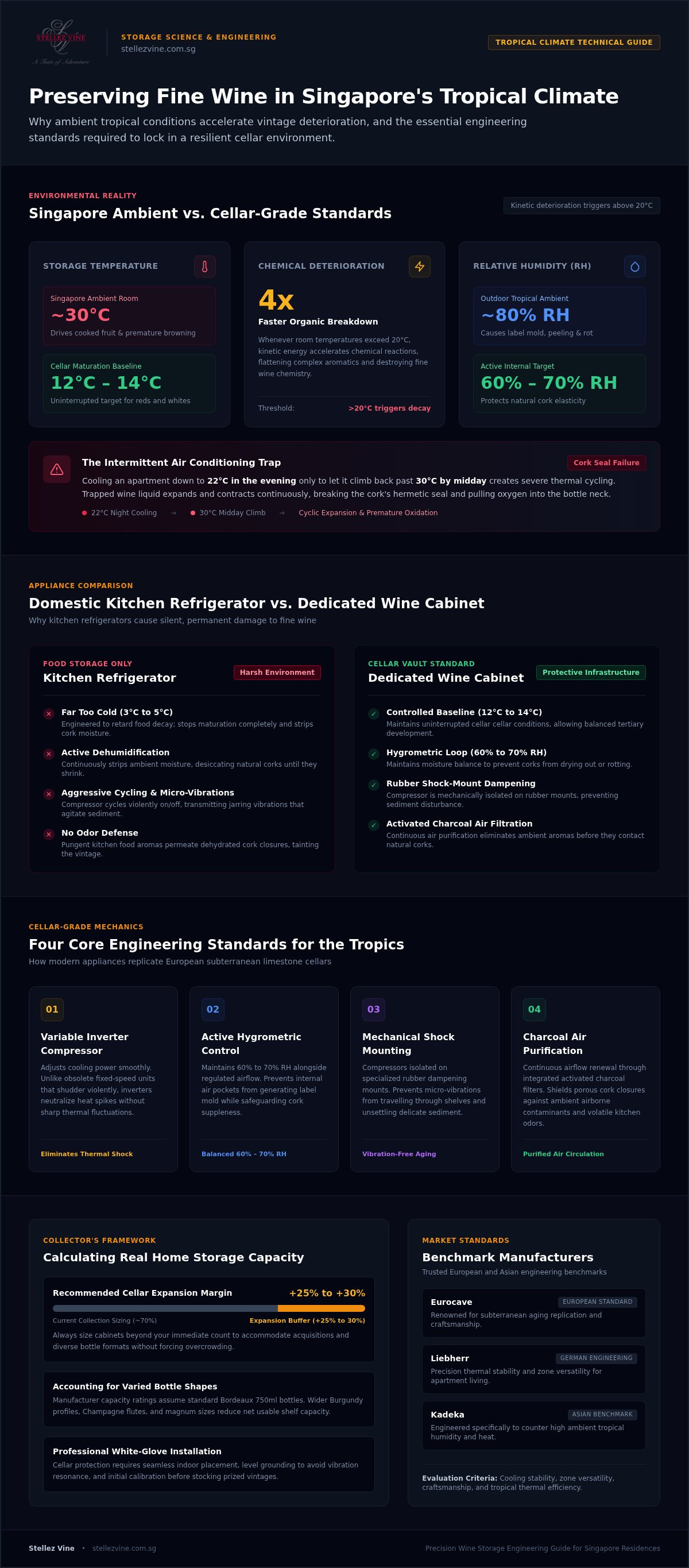
Best Wine Fridge Singapore: Premium Brands Buying Guide

In Singapore's relentless tropical climate, a dedicated wine fridge is protective infrastructure, not decorative furniture. You already know that leaving prized bottles exposed to persistent 30°C ambient heat and volatile humidity is a fast track to cooked fruit, dried corks, and spoiled investments. Standard kitchen refrigerators run far too cold, while generic beverage chillers lack the thermal stability needed to counter our tropical environment. Selecting the right wine fridge Singapore homes require comes down to precision climate engineering, active humidity balance, and vibration-free operation.
This buying guide shows you how to protect and cellar your collection with absolute confidence, locking in an unyielding 12°C to 14°C maturation baseline year-round. We explore the ideal capacity, zone architecture, and inverter compressor technology for apartment living, spotlighting trusted benchmarks from Eurocave, Liebherr, and Kadeka to help you choose the perfect appliance. Here is your roadmap to selecting authentic, cellar-grade storage tailored for your home.
Table of Contents
Tropical Climate Realities: Why Singapore Demands Dedicated Wine Storage
Core Engineering Standards for Preserving Wine in the Tropics
Comparing Benchmark Wine Fridge Brands: Eurocave, Liebherr, and Kadeka
The Buyer's Selection Framework: Capacity, Zones, and Space Planning
Curate and Protect: Sourcing Your Wine Storage with Stellez Vine
Tropical Climate Realities: Why Singapore Demands Dedicated Wine Storage
Fine wine is fragile chemistry held in delicate suspension. In Singapore, where ambient room temperatures routinely hover around 30°C, leaving bottles exposed on a sideboard or open rack accelerates chemical deterioration at an alarming pace. Whenever ambient temperatures exceed 20°C, kinetic energy speeds up organic reactions. Wine ages up to four times faster than intended, resulting in cooked fruit profiles, flattened aromatics, and premature browning. Investing in a premium wine fridge Singapore collectors trust acts as vital financial and sensory protection for your cellar, shielding rare bottles against thermal shock and swift ruin.
Many homeowners assume intermittent air conditioning offers sufficient respite. It doesn't. Cooling an apartment down to 22°C during evening hours only to let it climb back past 30°C by midday creates severe temperature swings. Understanding the fundamental principles of wine storage reveals why this cyclic expansion and contraction proves disastrous; it breaks the hermetic seal of the cork, pulling oxygen into the bottle neck and degrading pristine vintages before you ever pull the cork. If you're weighing the functional upside of dedicated climate gear versus passive room storage, explore our analysis on whether is a wine fridge worth it Singapore collectors often ask.
The Threat of Thermal Fluctuation and Humidity
Singapore's relentless 80% outdoor relative humidity presents unique preservation hazards. Without constant, regulated airflow, interior air pockets trigger heavy label mold and peeling. Conversely, unmanaged drafts desiccate natural corks. Fluctuating room climates continually compress and expand the trapped liquid, gradually compromising vintage integrity while muddling the intricate tertiary notes that define fine winemaking.
Kitchen Refrigerators vs Professional Wine Cabinets
Relegating fine wine to an ordinary domestic kitchen refrigerator causes silent harm. Standard refrigerators run between 3°C and 5°C, an environment engineered to retard food spoilage by actively stripping ambient moisture. These harsh conditions quickly dehydrate corks, allowing surrounding food odors to seep straight into the bottle. A purpose-built wine fridge Singapore residents rely on operates differently, pairing balanced humidity with quiet mechanical dampening:
Targeted climate control: Cabinets maintain an uninterrupted 12°C to 14°C maturation baseline rather than food-chilling extremes.
Vibration dampening: Domestic fridge compressors cycle aggressively, transmitting jarring micro-vibrations that disturb settling sediment and agitate delicate bottle aging. Dedicated units isolate the compressor on rubber shock mounts.
Odor filtration: Built-in activated charcoal filters continuously purify incoming airflow, preventing kitchen aromas from tainting natural cork closures.
Core Engineering Standards for Preserving Wine in the Tropics
A standard beverage cooler only chills canned drinks down to arbitrary cold temperatures. An aging cabinet, by contrast, operates as a calibrated vault designed to replicate the subterranean conditions of historical European limestone cellars. In our relentless climate, maintaining structural integrity inside the unit demands advanced mechanical systems. Modern inverter compressors serve as the heart of any capable wine fridge Singapore homeowners select. Unlike obsolete fixed-speed compressors that shudder violently as they turn on and off, variable-speed inverter compressors adjust their cooling power smoothly. They offset tropical heat spikes without producing sharp thermal fluctuations or energy surges.
For collectors preserving investment-grade bottles over decades, mastering the mechanics of long term wine storage Singapore environments necessitate is the only way to avoid premature degradation. True aging cabinets unite thermal control with dedicated hygrometric loops, shielding fragile natural corks from drying out or rotting.
Precision Temperature and Active Humidity Regulation
Authentic maturation requires an unyielding baseline between 12°C and 14°C for both reds and whites. Dedicated cabinets balance this temperature with an internal relative humidity of 60% to 70%. Integrated condensation management channels recycle airborne moisture to nourish cork elasticity, while active drainage systems prevent stale pooling water from softening labels. Internal sensors continuously monitor micro-zones, immediately making micro-adjustments if room temperatures rise.
Vibration Dampening and UV Radiation Shielding
Light and mechanical motion are invisible enemies of fine wine. Premium cabinets incorporate several structural barriers to safeguard delicate bottles:
Kinetic isolation: Slow-cycling compressors rest on specialized rubber shock mounts, ensuring kinetic energy never transfers to resting bottles.
Acoustic absorption: Solid, unvarnished wooden shelving cradles each bottle, absorbing ambient harmonics and preventing chemical disruption of fine sediments.
Argon-filled glass barriers: Double or triple-glazed doors treated with low-emissivity coatings deflect harmful ultraviolet rays. This protects organic tannins from irreversible lightstrike damage while keeping internal chill isolated.
Selecting an appliance built to these precise mechanical benchmarks guarantees your collection matures exactly as the winemaker intended. If you want to evaluate certified systems designed for our local climate, explore the curated cellar solutions at Stellez Vine to discover appliances tailored to your space.
Comparing Benchmark Wine Fridge Brands: Eurocave, Liebherr, and Kadeka
Every serious collector arrives at a pivotal crossroads when choosing storage hardware. Finding the right wine fridge Singapore residences require means balancing engineering heritage, cooling mechanisms, and spatial constraints. Rather than settling for broad retailer catalogs that group disparate appliances together, discerning buyers evaluate dedicated brands based on real-world cellar performance. Stellez Vine serves as an authorized retailer for the three defining names in modern preservation: Eurocave, Liebherr, and Kadeka. Each platform delivers distinct mechanical strengths matched to specific collector priorities.
Eurocave: The Gold Standard for Long-Term Maturation
Handcrafted in France, Eurocave remains the undisputed benchmark for serious cellaring. Patented cellular insulation and internal relief walls recreate the natural breathing dynamic of historic underground vaults. If your collection centers on rare Bordeaux growths, grand cru Burgundy, or bottles meant to mature undisturbed across generations, Eurocave offers incomparable thermal permanence.
Liebherr: German Precision and Climate Engineering
German engineering defines Liebherr's approach to thermal control. Advanced sensors maintain razor-thin temperature bands, while FreshAir activated charcoal filters actively strip external kitchen odors before air enters the interior chamber. Liebherr excels in multi-temperature versatility, offering independent cooling zones that let you hold serving-temp Champagne and aging reds in a single chassis. Review our dedicated Liebherr wine cabinet Singapore guide to explore their climate technologies in detail.
Kadeka: Contemporary Innovation and Space Efficiency
Kadeka leads the market in urban versatility and modern compressor engineering. Recognizing the aesthetic and acoustic demands of Singapore apartment living, Kadeka prioritizes whisper-quiet inverter systems with sleek exterior designs. Their connoisseur-focused shelving handles wider Champagne bases and irregular bottles effortlessly, avoiding torn labels or jammed sliding tracks.
Match your storage strategy to the brand architecture that serves it best:
The Generational Investor: Choose Eurocave for absolute humidity control, dark aging environments, and unmatched historical provenance.
The Versatile Entertainer: Turn to Liebherr for flexible multi-zone staging, robust digital interfaces, and German build quality.
The Modern Urban Collector: Select Kadeka for whisper-quiet inverter performance, flexible installation depths, and wide-format shelf versatility.
Choosing between these platforms is never about finding an arbitrary winner. It's about matching mechanical engineering to the bottles you love most.
The Buyer's Selection Framework: Capacity, Zones, and Space Planning
Manufacturers calculate advertised storage capacities using traditional, uniform Bordeaux bottles. If your palate leans toward Champagne, Burgundy, or Rhône varietals, those wider bases reduce real-world shelf volume by roughly 20%. When choosing a wine fridge Singapore apartments can comfortably accommodate, always calculate your immediate bottle count and add a 25% to 30% margin. This buffer accommodates wider silhouettes and gives your collection room to expand organically without forcing you to stack bottles haphazardly.
Single-Zone vs Dual-Zone Temperature Configurations
Your drinking habits should dictate zone architecture. Single-zone units lock in an unyielding 12°C baseline, making them the preferred format for long-term cellaring where thermal stability takes precedence over immediate serving readiness. Dual-zone models split your interior volume, allowing you to chill sparkling and white wines to 7°C while holding reds at an approachable 16°C. Multi-temperature cabinets create a gradual vertical gradient, giving you immediate serving access across multiple styles simultaneously.
Ventilation, Placement, and Apartment Integration
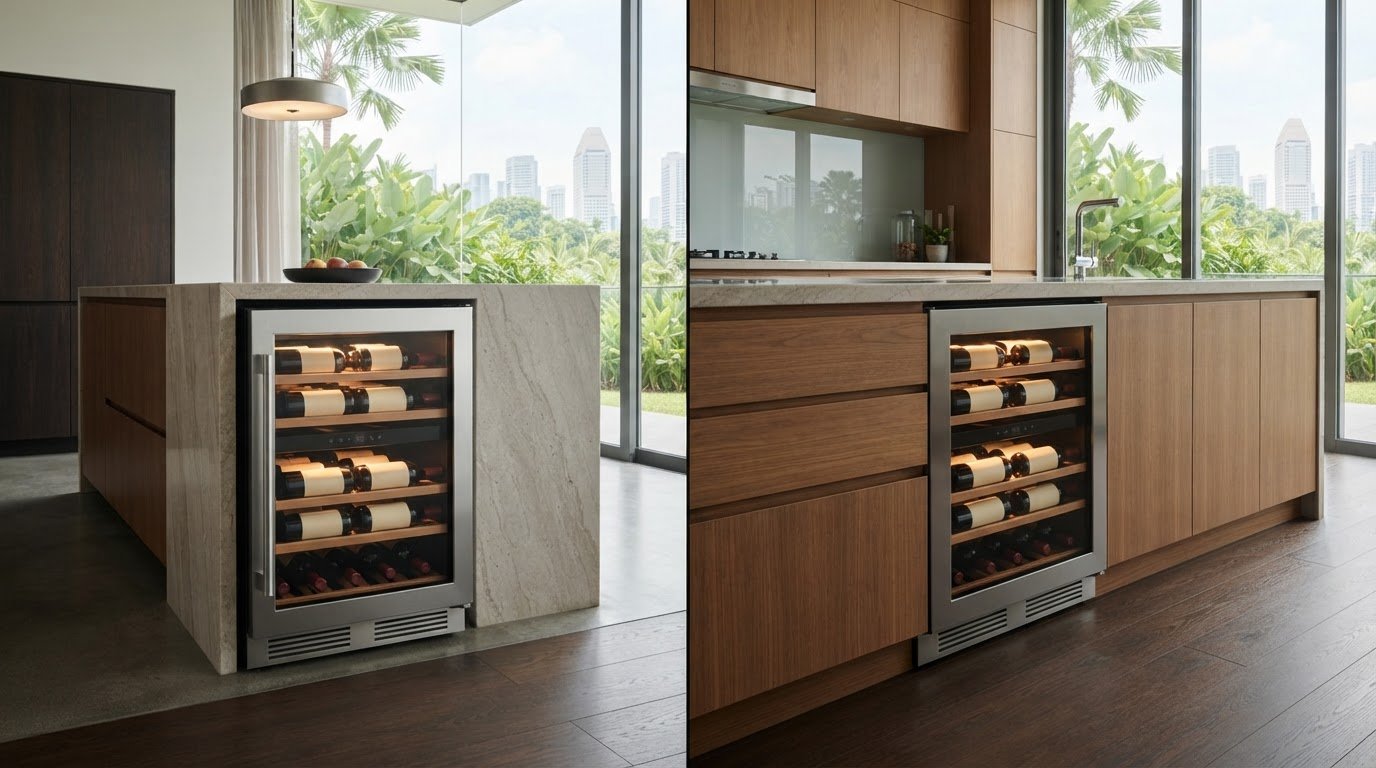
Proper ventilation preserves your compressor's lifespan in tropical ambient conditions. Built-in under-counter installations require front-venting plinths that expel warm air forward into the room. Placing a freestanding unit flush against closed cabinetry traps hot air, forcing the motor to run continuously until it burns out. For freestanding models, leave at least five to ten centimeters of rear and side clearance. Position your cabinet far from radiant heat sources like ovens, induction cooktops, or glass doors receiving direct afternoon sun. Consider physical door locks to secure valuable vintages, along with digital alarms that notify you if a seal is compromised.
To find an appliance perfectly scaled to your home's layout, browse the curated wine storage collection at Stellez Vine and consult with our specialists to safeguard your investment.
Curate and Protect: Sourcing Your Wine Storage with Stellez Vine
Finding the ultimate storage solution shouldn't end with a curbside drop-off and an unassisted setup. Stellez Vine bridges the gap between engineering excellence and world-class wine curation, operating as Singapore's dedicated destination for both cellar-grade hardware and exceptional bottles. As an authorized retailer for industry benchmarks Eurocave, Liebherr, and Kadeka, we eliminate the uncertainty of acquiring a wine fridge Singapore collectors can trust for decades. You receive full factory warranty backing, genuine manufacturer support, and specialized guidance tailored precisely to your entertaining lifestyle and collection size.
White-Glove Delivery and Installation Across Singapore
Transporting sensitive refrigeration equipment across the island demands specialized care. Our white-glove logistics service ensures cabinets remain strictly upright during transport, guarding delicate compressor lubricants against shifting into internal cooling coils. Experienced technicians deliver the unit directly into your residence, level the base to isolate mechanical vibrations, and provide essential pre-cooling guidance so the internal climate stabilizes completely before you transfer your bottles.
Uniting Fine International Labels with World-Class Cellarage
A calibrated storage cabinet deserves equally pristine contents. Beyond appliances, Stellez Vine curates rare and distinctive labels handled through unbroken, temperature-controlled logistics from vineyard to cellar. Discover handpicked allocations across our portfolio:
Iconic European and New World estates: Historic Right Bank releases from Chateau Canon Chaigneau, Italian classics from Casa Vinicola Caldirola, and high-altitude Argentinian selections from Matias Riccitelli.
Artisanal and emergent regions: Boutique South African cuvées from Savage Wines, alongside pioneer estates including GranMonte in Thailand and Mystic Island in China.
Specialized accessories: Fine glassware designed to showcase the aromatics and complexity of mature vintages.
Consult with our team to align your cabinet capacity with an evolving cellar journey, securing both the vintages you cherish and the protective climate control required to enjoy them at peak maturity.
Protect Your Investment and Elevate Every Pour
Preserving fine wine in the tropics requires intention, precision, and the right mechanical defense. Singapore's ambient heat and volatile humidity don't compromise when it comes to delicate cork seals and intricate aromatic compounds. Choosing a benchmark wine fridge Singapore collectors trust transforms your residence into a dependable sanctuary for aging vintages, locking in steady temperatures, balanced hygrometry, and total vibration isolation.
Whether you need the generational cellaring pedigree of Eurocave, the German climate precision of Liebherr, or the sleek urban versatility of Kadeka, Stellez Vine stands ready as your authorized partner. We pair professional-grade storage with dedicated white-glove national delivery, expert consultation, and an exclusive portfolio of handpicked international wines. Take the decisive step to safeguard your cellar today. Explore Premium Wine Cabinets at Stellez Vine and savor every vintage exactly as the winemaker intended.
Frequently Asked Questions
Can I use a regular kitchen refrigerator to store my wine in Singapore?
No, a regular kitchen refrigerator is unsuitable for storing wine long-term. Kitchen fridges operate around 3°C to 4°C, which is far too cold for natural maturation and quickly strips essential moisture from corks. As corks dry out, oxygen enters and spoils the liquid. Harsh motor vibrations also agitate delicate sediment, while food aromas permeate the bottle. A purpose-built wine fridge Singapore collectors trust maintains a steady 12°C to 14°C with active humidity balance.
What is the ideal temperature setting for a wine fridge in Singapore?
The ideal temperature setting for aging both red and white wine is an unvarying 12°C to 14°C. While ideal serving temperatures vary, sparkling wines prefer 6°C to 8°C and full-bodied reds show best around 16°C, long-term maturation demands an unwavering baseline. Fluctuations degrade delicate aromatics. A premium cabinet keeps internal temperatures steady despite Singapore's high ambient heat, allowing complex tannins and fruit notes to develop exactly as the winemaker intended.
How much extra capacity should I buy when choosing a wine fridge?
You should buy 25% to 30% more capacity than your current bottle count. Standard manufacturer capacity ratings assume uniform 750ml Bordeaux bottles. If your collection contains Burgundy, Champagne, or Rhône selections, their wider diameters reduce usable shelf volume quickly. Planning extra headroom ensures you won't need to force or stack bottles awkwardly. It also gives your cellar room to expand organically without requiring an immediate secondary cabinet.
What happens if a wine fridge is exposed to Singapore's high humidity?
High ambient humidity causes heavy exterior condensation on poorly insulated glass doors and encourages mold growth if internal airflow is stagnant. Premium cabinets counter this with multi-glazed, argon-filled glass and active internal hygrometry loops. These engineering features keep relative humidity between 60% and 70%, preserving cork elasticity without soaking labels. Inferior chillers lack proper condensation management, which lets standing water pool and damage both bottles and shelving.
Is a dual-zone wine fridge better than a single-zone cabinet?
A dual-zone wine fridge is better for entertaining, while a single-zone unit is superior for long-term cellaring. Dual-zone models let you hold whites and reds at distinct, immediate serving temperatures in the same chassis. However, if your primary goal is aging fine vintages over years, a single-zone wine fridge Singapore buyers select offers greater thermal stability across the entire interior. It eliminates thermal bleed between compartments, providing rock-solid consistency.
How do inverter compressors reduce energy consumption in tropical climates?
Inverter compressors run continuously at variable, calibrated speeds rather than cycling abruptly between full blast and complete shutdown. Because Singapore's ambient warmth constantly challenges cooling appliances, traditional fixed-speed compressors consume large bursts of electricity every time they restart. Inverter units adjust motor output smoothly to meet real-time cooling demands. This continuous, low-rpm operation prevents sudden temperature spikes, lowers energy consumption, and extends overall appliance lifespan.
Can I build a freestanding wine fridge directly into my kitchen cabinetry?
No, you should never enclose a freestanding wine fridge inside flush cabinetry. Freestanding units dissipate heat through their side and rear exterior panels, requiring at least five to ten centimeters of open breathing space to prevent overheating. Trapping that hot air inside tight millwork strains the motor and leads to compressor failure. If you desire a seamless under-counter look, select a purpose-built front-venting model designed to intake and exhaust air through the front base plinth.

Comments